Written in 2026 for this archive, not by the Oregon Water Coalition. It explains background that the restored pages take for granted; check current rules with the agencies named in the sources before acting on anything here.
Most arguments about water in eastern Oregon can be checked against a public record. Who holds the oldest right on a creek, how deep a neighbor's well goes, what the river did last August, what the state's nitrate report actually says: all of it is online, scattered across a handful of agency systems with names only an insider loves. This guide is for students writing papers, reporters on deadline, and district or city staff answering a board member's question. It covers where to look, what each source can and cannot tell you, and how to cite it so a reader can follow your trail.
Start with the question, not the database
Water questions fall into a few types, and each has a home:
- Who may use water, and in what order? Water rights records at the Oregon Water Resources Department (OWRD).
- What is under the ground? Well reports and groundwater data, also at OWRD.
- How much water is in the river or reservoir? Stream gauges run by OWRD and the U.S. Geological Survey.
- How much snow is up high? Natural Resources Conservation Service snow surveys, covered in our snowpack and drought guide.
- Is the water clean? Oregon DEQ reports and monitoring, such as the nitrate work behind the Lower Umatilla Basin groundwater guide.
- What does the law say? Statutes, rules and bills, and the history behind them, much of it summarized in our guide to HB 3111 and Columbia River water laws.
Water rights: OWRD's record systems
OWRD's data page is the front door. The tools a researcher uses most:
- Water Rights Information System (WRIS). A database of water right applications, permits, certificates, transfers and leases. You can search by file number, location, name or stream. OWRD publishes a code sheet that explains the abbreviations.
- Platcard report. A list of every water right in a given township, range and section, with priority dates, uses and status. Start here when you know a place but not a name.
- Place of use and point of diversion summaries. At-a-glance totals of acres, rates in cubic feet per second, and duty in acre-feet for an area.
- Statewide water right spatial data. A GIS download that OWRD says is updated every night from its central database.
- Water Availability Report System. How much water is still available for new consumptive uses at a point on a stream.
- Water Use Report. Reported use. Public entities must measure and report, as must holders whose permits or certificates require it.
- Document Vault. Scanned copies of documents, retrievable if you know the document name or number.
Groundwater: well logs and the GWIS
The Find a Well Report database covers most wells constructed in Oregon since approximately 1960. You search by township, range and section, or on a map. A well report, or well log, records how the well was built and the geology the driller passed through, which is how researchers trace basalt aquifers under Umatilla and Morrow counties. The Groundwater Information System (GWIS) holds the groundwater section's other data. OWRD also runs a mapping tool where owners record exempt-use wells, which state law requires within 30 days of completion.
Rivers and reservoirs: OWRD and USGS gauges
OWRD publishes historical and near-real-time streamflow and lake level data for its own stations, plus a database of miscellaneous field measurements. The federal side is USGS Water Data for the Nation, which describes itself as "over 135 years of water data from more than one million monitoring locations," including more than 13,500 real-time sites. Each location page shows who collects the data and what kinds are available: continuous, daily, field measurements or discrete samples. For larger projects USGS offers web APIs and the dataRetrieval package for R and Python.
Reports, laws and the archive itself
Agency reports are often the best single source for a paper, because someone has already done the analysis and stated the method. Search the issuing agency's site first, then the publications page of the relevant program. For statutes, OregonLaws is easy to read and links each section to its official source on the Legislature's site; cite the official text in formal work.
This archive is a source too, with care. Many blog posts from 2007 to 2016 were reposts from regional outlets, above all the Columbia Basin Bulletin, and kept the original source line at the end. Cite the original outlet and date where one is given, and use the archive address as where you found it. The coalition's own pages, from its fact sheets to its resources post of 2017, are the coalition speaking for itself, and should be quoted as advocacy, not as neutral data.
Which source answers what
| Question | Source | What you get | Cite as |
|---|---|---|---|
| Who holds the senior right on a creek? | OWRD WRIS, Platcard report | priority dates, uses, status | database page with retrieval date, or the certificate itself |
| How was a well built? | OWRD Find a Well Report | construction and geology log | the well report by its ID |
| What was the flow last summer? | USGS Water Data for the Nation, OWRD streamflow | daily and continuous flow | the published record; retrieval date if live |
| How much new water is available? | OWRD Water Availability Report System | availability by stream point | database page with retrieval date |
| What did the state find about nitrate? | DEQ reports | analysis and conclusions | government report |
| What does the statute say? | ORS (official), OregonLaws (reading copy) | text and history notes | statute section |
Citing government reports and data in APA style
Most school assignments in this field use APA style, seventh edition. Three rules from the APA's own reference examples cover nearly everything above.
Reports by an agency. The specific agency that wrote the report is the author. Parent agencies not named in the author go in the publisher position. That keeps in-text citations short while the reference list stays complete. The pattern is:
Agency name. (Year). Title of report in italics (Report number, if any). Parent agency. URL
Data sets. APA says to cite a data set when you have analyzed archived data yourself. If you are only quoting a statistic, cite the publication where it appeared instead. The title goes in italics, followed by any identifier and version in parentheses, then a bracketed description such as [Data set]. A real USGS example: the agency's list of 20 priority saline lakes in the Great Basin, including six in Oregon, was published as a data release with a DOI. A reference for it would read:
Qi, S. L. (2024). Saline Lake Ecosystems IWAA lakes (ver. 2.0, September 2026) [Data set]. U.S. Geological Survey. https://doi.org/10.5066/P13QP2TK
Pages that change. For a webpage whose content is designed to change and is not archived, APA asks for a retrieval date: "Retrieved [date], from [URL]." Live gauge pages, drought status reports and database search results all fall here. Save a PDF or screenshot of what you saw on that date; numbers on live pages can be revised.
Formatting dozens of these by hand is slow and error-prone. If you want a head start, Structora's free APA 7 and MLA 9 citation helper assembles the entries, and you can then check agency names, versions and retrieval dates against the rules above. Tools get group authors wrong more often than people's names, so read every line.
A short checklist before you hand it in
- Every number has a source a reader can open.
- Live data carries a retrieval date, and you saved a copy.
- Reposted news items cite the original outlet, not only this archive.
- Advocacy documents, including the coalition's, are labeled as such in your text.
- Statutes are checked against the official version.
- Water rights are described in the terms the records use: permit, certificate, transfer, lease, priority date.
For background on that vocabulary, start with our guide to Oregon water rights. Students heading toward a water degree may also want our note on the coalition's scholarship and water career paths.
Public meetings as a source
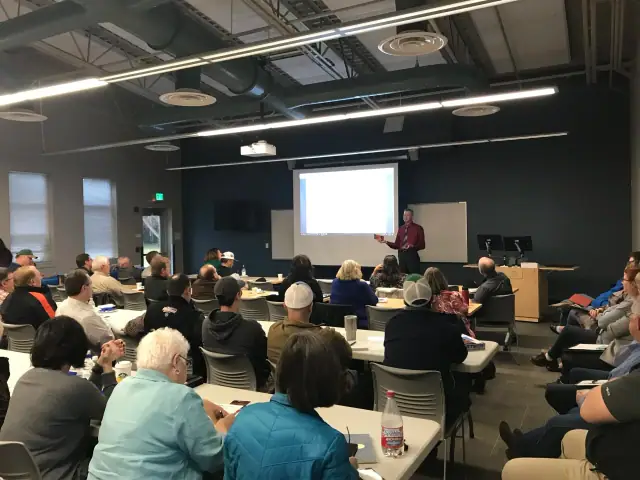
One more record that researchers forget: the meetings themselves. Oregon's Public Meetings Law requires the governing body of a public body to give notice of regular meetings "reasonably calculated to give actual notice to interested persons," with a list of the principal subjects to be considered, and at least 24 hours' notice of a special meeting. Irrigation district boards, county courts and city councils all meet in public, and their agendas and minutes often explain a decision better than any database. Ask the district office for minutes if they are not posted online, and cite them by body, meeting date and title.
Questions people ask
Where do I look up who holds a water right in Oregon?
In the Oregon Water Resources Department's Water Rights Information System (WRIS). It holds records of applications, permits, certificates, transfers and leases, and can be searched by file number, location, name or stream. The Platcard report lists every right in a township, range and section.
Can I find the log for a well on a property?
Usually. OWRD keeps a database of most wells built in Oregon since about 1960, searchable by township, range and section or on a map. A well report records how the well was built and what the driller found.
How do I cite live streamflow or gauge data in APA style?
If you are citing a published figure, cite the report or webpage where it appeared. If you cite a page whose content changes over time and is not archived, APA asks you to add a retrieval date. For a formal data release with a DOI, cite it as a data set, with the version in parentheses and [Data set] in brackets.
Is OregonLaws the official version of state statutes?
No. OregonLaws (oregon.public.law) republishes the Oregon Revised Statutes and notes the official source on the Legislature's website. It is convenient for reading; for a formal citation or anything with legal consequences, check the official text.
Sources
- Oregon Water Resources Department, Access Data/Maps: Data
- OWRD, Water Rights Information Query (WRIS)
- OWRD, Well Report Query
- U.S. Geological Survey, Water Data for the Nation
- USGS, Saline Lake Ecosystems IWAA Lakes (ver. 2.0, September 2026), data release
- APA Style, Report by a Government Agency References
- APA Style, Data Set References
- APA Style, Webpage on a Website References
- ORS 192.640, public notice of meetings (OregonLaws, with source note to the official ORS)