Written in 2026 for this archive, not by the Oregon Water Coalition. It explains background that the restored pages take for granted; check current rules with the agencies named in the sources before acting on anything here.
Drive I-84 between Boardman and the Umatilla River and you see three economies side by side. Center pivots cover the benchland. Potato and onion sheds and cold storage line the frontage roads. And long, windowless buildings with substations beside them keep rising on what used to be sagebrush. Water ties the three together: who gets it, how it is reused, and what ends up in the aquifer.
The towns
Hermiston, in western Umatilla County, had 19,354 people in the 2020 census. It sits near the junction of I-82 and I-84, seven miles south of the Columbia and McNary Dam, and serves as the retail and services center for western Umatilla County, Morrow County and parts of Gilliam County. The city is known for its watermelons, which are part of its branding.
Boardman, on the Columbia in Morrow County, had 3,828 people in 2020, up from 3,220 in 2010, and is the county's largest town. It was homesteaded in 1903 by Samuel H. Boardman, who later became the first superintendent of Oregon's state parks.
Morrow County as a whole had 12,186 residents in 2020. Heppner is the county seat. Its principal industries are agriculture, food processing, lumber, livestock and recreation, with energy and data centers now large additions.
Farming: irrigated, high-value, processing-heavy
The state's 2024 Nitrate Reduction Plan gives a concise picture of agriculture in the lower basin. Sandy loam soils, gentle terrain, climate and well-developed irrigation give the area, in the plan's words, some of the best conditions in the world for producing vegetable root crops. Potatoes, onions and carrots lead, with seed crops, wheat, sweet corn, silage corn, blueberries, melons, livestock and hay. A 2017 USDA summary cited in the plan ranked Morrow County second and Umatilla County fourth among Oregon counties in agricultural production.
That economy grew in steps:
- Wheat and cattle came first.
- In the 1970s, low power costs and center-pivot irrigation drove a big expansion of potato acreage, and Lamb Weston and Simplot built large frozen-potato plants. Hermiston's population roughly doubled from 4,893 in 1970 to 9,408 in 1980.
- Dairy expanded after Tillamook opened its plant at the Port of Morrow in 2001.
- Since 1992, irrigated acreage inside the groundwater management area has grown about 10 percent, with roughly 33,000 acres added, mostly between the north end of Towers Road and the Boardman Bombing Range.
Most of the land stays agricultural by law. About 83.5 percent of the groundwater management area, some 300,448 acres, is zoned exclusive farm use.
Behind all of it is a network of local equipment dealers, irrigation suppliers, agronomists, trucking firms and repair shops, and the region's farms lean on them hard during planting and harvest.
The Port of Morrow
The Port of Morrow, established in 1959 according to the port, has become the economic center of Morrow County. Its own fact sheet lists:
- second-largest port in Oregon, shipping processed food, forest products, grain, root vegetables, cattle and dairy;
- more than 5,000 acres of undeveloped industrial land in four parks: Airport, Boardman, East Beach and South Morrow;
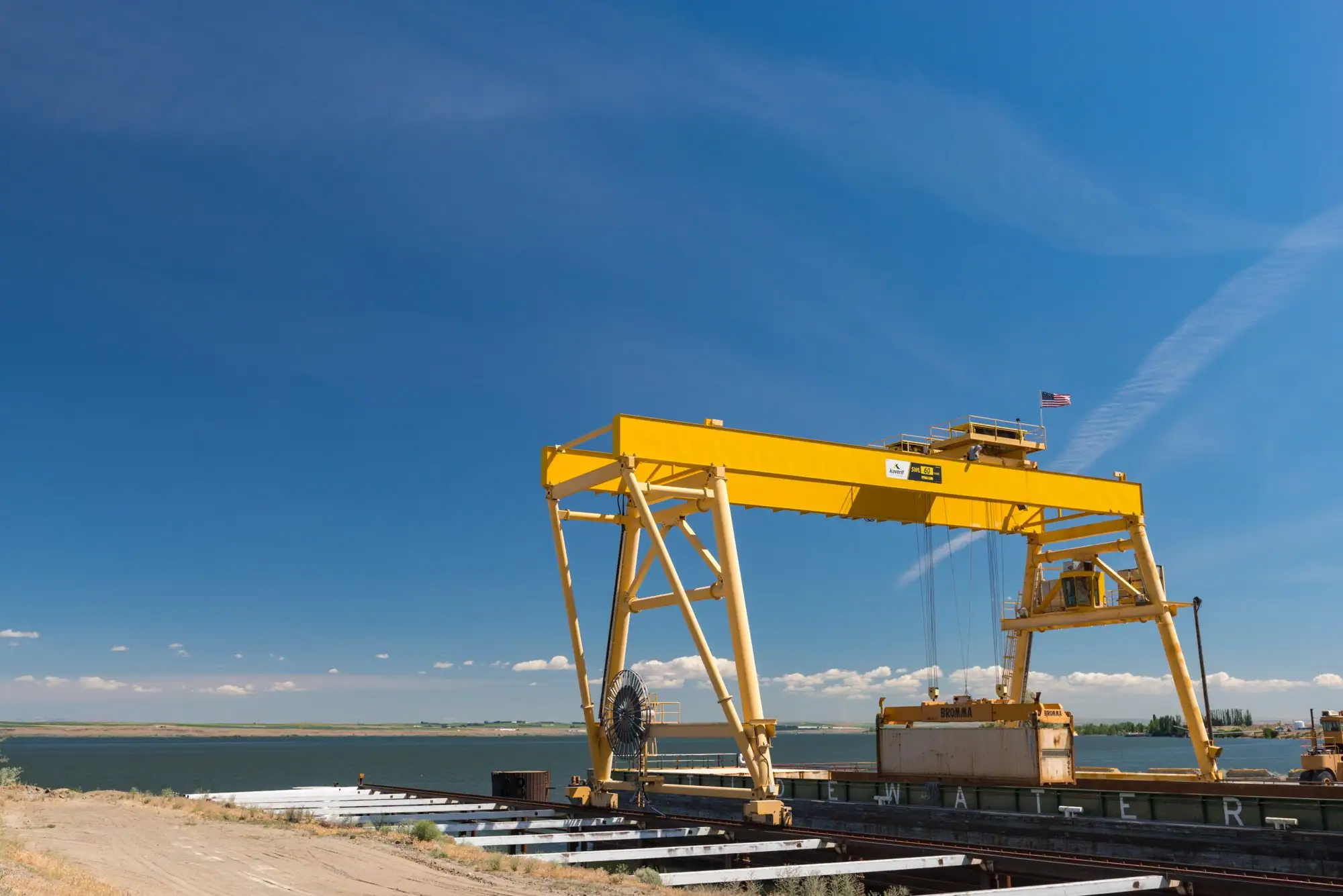
- a container terminal handling about 11,000 containers a year, the largest upriver from Portland;
- a Union Pacific rail loop at the East Beach park;
- more than 6,700 permanent jobs, $2.5 billion in annual output and $400 million in labor income in its economic impact estimate;
- about 3 billion gallons of industrial wastewater cooled and processed each year for reuse as irrigation on local farms.
The port says businesses connected to it employ half the region's workforce, and that Morrow County's wages are now the fourth highest in Oregon. It also hosts a Blue Mountain Community College workforce training center and the SAGE Center, a visitor and education center that opened in 2013. For students weighing irrigation technology, water science or water law, our guide to water career paths after the coalition's scholarship covers the programs closest to home.
| Indicator | Figure | Source |
|---|---|---|
| Hermiston population (2020) | 19,354 | U.S. Census via Wikipedia |
| Boardman population (2020) | 3,828 | U.S. Census via Wikipedia |
| Morrow County population (2020) | 12,186 | U.S. Census via Wikipedia |
| Port undeveloped industrial land | 5,000+ acres | Port of Morrow |
| Port wastewater reused for irrigation | about 3 billion gallons a year | Port of Morrow |
| Largest Hermiston-area employer (2022) | Amazon Web Services, 2,058 jobs | City of Hermiston report via Wikipedia |
The data center build-out
The Oregonian reported in November 2008 that Amazon was building a large data center at the Port of Morrow, and it began operating in 2011. By August 2018, the East Oregonian reported two Amazon data centers in Boardman and one in Umatilla, with four more proposed. In 2022, The Oregonian reported Amazon was seeking tax breaks for at least five more data centers in Morrow County, a package worth almost $12 billion. In Hermiston's 2022 financial report, Amazon Web Services was the largest employer in the area, with 2,058 jobs.
Several advantages show up in the sources: low power costs, the I-82/I-84 interchange, the Pacific Northwest fiber-optic backbone and plenty of industrial land. The port adds one more. It says its industrial wastewater reuse system has been a significant factor in attracting food processing, data centers and other manufacturers.
Construction of this scale also supports a large local trade: electrical, mechanical and civil contractors, plus the IT, networking and web services firms that local businesses use as broadband and tech work expand in the area.
Power
The load is large. Oregon Department of Energy data show the commercial sector's share of statewide energy use rising from 16 to 20 percent between 2022 and 2024, the highest on record, with data center expansion the main reason it gives. ODOE also reports that forecast data center growth is now the biggest single reason Oregon is off track for its climate goals, unless that demand is met with clean power. Two gas-fired plants, Coyote Springs I and II, sit at the port, and the Boardman coal plant closed in October 2020 as the last coal plant in Oregon.
Water: supply, reuse and groundwater
Water questions here fall into three groups.
Supply. Much of the basalt groundwater under the area is already restricted. The Ordnance Critical Groundwater Area has been closed to new appropriations since an order dated April 2, 1976, and the Butter Creek area since August 18, 1986. New farm supply has largely come from the Columbia, through pipelines and the federal Umatilla Basin exchange, covered in our separate guides.
Reuse. The port collects wastewater from food processors, storage facilities and data centers and sends it to farms as irrigation water carrying nitrogen. OPB reported that the port agreed in 2022 to spend $200 million on treatment and storage upgrades, and the port now puts that investment above $400 million. New lagoons that OPB said would hold an additional 1.5 billion gallons were due to start operating by November 1, 2025, so the port can stop land application in winter. The port says water reuse brings in 21 percent of its revenue but took 77 percent of its capital spending in 2024–2025.
Groundwater quality. The area sits inside the Lower Umatilla Basin Groundwater Management Area, designated in 1990 for nitrate. The 2024 state plan names irrigated farmland as the largest estimated source, about 70 percent, and lists food processing, data centers, distribution and energy among the major industries that are significant water users with major wastewater needs. DEQ has fined the port repeatedly for over-applying wastewater.
The data center link is contested. Plaintiffs in a 2024 federal lawsuit allege that nitrate-laden water used to cool servers at Amazon's Port of Morrow facilities becomes more concentrated as it evaporates and is then applied to fields. Amazon denied contributing to the contamination and noted that groundwater problems predate its data centers. In March 2026 it agreed to a $20.5 million settlement without admitting liability, subject to court approval. Claims against other defendants, including the port, food processors and large farms, continued at the time of that report.
Living and doing business here
For residents, the practical advice is simple. If you drink from a private well, test it; the Oregon Health Authority offers free testing in the groundwater management area.
For businesses, the growth cuts both ways. Demand for skilled trades, logistics, and tech and web services keeps rising with the industrial parks, and water, power and wastewater are the questions every new project has to answer first. Newcomers also change how customers find local firms: fewer referrals over the counter, more searches on a phone. Suppliers, dealers and even irrigation districts now need a website people can find and use, and districts face a federal accessibility deadline for their web content. Our guide to websites, search and advertising for irrigation districts, growers and farm suppliers walks through what each kind of organization needs online.
Questions people ask
Why did data centers locate around Boardman and Hermiston?
Sources point to a combination of factors: low power costs, access to the Pacific Northwest fiber-optic backbone, the I-82 and I-84 interchange, large industrial sites, and the Port of Morrow's industrial water and wastewater system, which the port itself credits with attracting data centers and food processors.
How big is the Port of Morrow?
The port describes itself as Oregon's second-largest port, with more than 5,000 acres of undeveloped industrial land across four industrial parks, and reports an economic impact of more than 6,700 permanent jobs and $2.5 billion in annual output.
Do data centers affect groundwater in Morrow County?
It is disputed. Plaintiffs in a federal lawsuit allege that cooling water at Amazon's Port of Morrow facilities concentrated nitrate before the port's wastewater was applied to farm fields. Amazon denied contributing to the contamination and settled for $20.5 million in 2026 without admitting liability.
What crops is the Hermiston–Boardman area known for?
Potatoes, onions and carrots are the major root crops, along with seed crops, wheat, sweet corn, silage corn, blueberries, melons, livestock and hay, according to the state's 2024 Nitrate Reduction Plan. Hermiston uses its watermelons as part of the city's branding.
Sources
- Port of Morrow, 10 Facts About the Port of Morrow
- Oregon Nitrate Reduction Plan for the LUBGWMA (2024)
- Wikipedia, Boardman, Oregon
- Wikipedia, Hermiston, Oregon
- Wikipedia, Morrow County, Oregon
- OPB / Oregon Capital Chronicle, Amazon to pay $20.5 million settlement (Mar. 31, 2026)
- OPB, Port of Morrow to spend $200 million for water quality improvements (Dec. 2022)
- OPB, Oregon DEQ again fines Port of Morrow for wastewater violations (Sept. 30, 2025)
- Oregon Department of Energy, 2026 Biennial Energy Report: Energy by the Numbers
- OAR 690-507-0080, Butter Creek Subbasin (OregonLaws)