Written in 2026 for this archive, not by the Oregon Water Coalition. It explains background that the restored pages take for granted; check current rules with the agencies named in the sources before acting on anything here.
Since 1990, a slice of northeastern Oregon has carried a formal state designation that most residents never think about until they test their well. The Lower Umatilla Basin Groundwater Management Area, usually shortened to LUBGWMA, exists because nitrate in the shallow groundwater beneath Morrow and Umatilla counties has been measured above drinking water limits for more than three decades. This guide sets out what the designation is, what the monitoring shows and what the state and others are doing about it, using agency records first.
The 1990 designation
Oregon's Groundwater Protection Act of 1989 directed the Department of Environmental Quality (DEQ) to declare a groundwater management area when widespread contamination, mainly from nonpoint sources, passes set alert levels. For nitrate, that trigger is 7 milligrams per liter, which is 70 percent of the federal drinking water standard of 10 mg/L.
DEQ declared the Lower Umatilla Basin a groundwater management area in 1990, after nitrate contamination was identified beneath about 352,000 acres of northern Morrow and Umatilla counties. The 2024 state plan describes the area as roughly 550 square miles, taking in Hermiston, Boardman, Irrigon, Stanfield, Echo and surrounding rural land.
It is one of three groundwater management areas in Oregon, all designated for nitrate. The others are Northern Malheur County (1989) and the Southern Willamette Valley (2004).
| Item | Figure | Source |
|---|---|---|
| Year declared | 1990 | DEQ |
| Area at designation | about 352,000 acres | DEQ trend analysis, 2025 |
| Current description | about 550 square miles | Nitrate Reduction Plan, 2024 |
| State alert level | 7 mg/L nitrate-N | DEQ |
| Federal drinking water standard | 10 mg/L | DEQ, OHA |
| Wells in DEQ trend network | 33 | DEQ trend analysis, 2025 |
| Network wells over 10 mg/L recently | about 40 percent | DEQ trend analysis, 2025 |
Why nitrate matters
Nitrate in drinking water is mainly a concern for infants and pregnant people. The Oregon Health Authority (OHA) warns that formula-fed babies given high-nitrate water are at risk of blue baby syndrome, a condition that limits the blood's ability to carry oxygen. OHA also cites some evidence of higher risk of miscarriage and certain birth defects at 10 mg/L or more, and advises that boiling water does not remove nitrate; it concentrates it.
The exposure question is mostly about private wells. DEQ is direct about this: if your water comes from a city or community system, it is safe to drink, because public systems test regularly and must meet standards. Private domestic wells are not regulated that way. Under federal and state law, owners are generally responsible for testing them.
Where the nitrate comes from
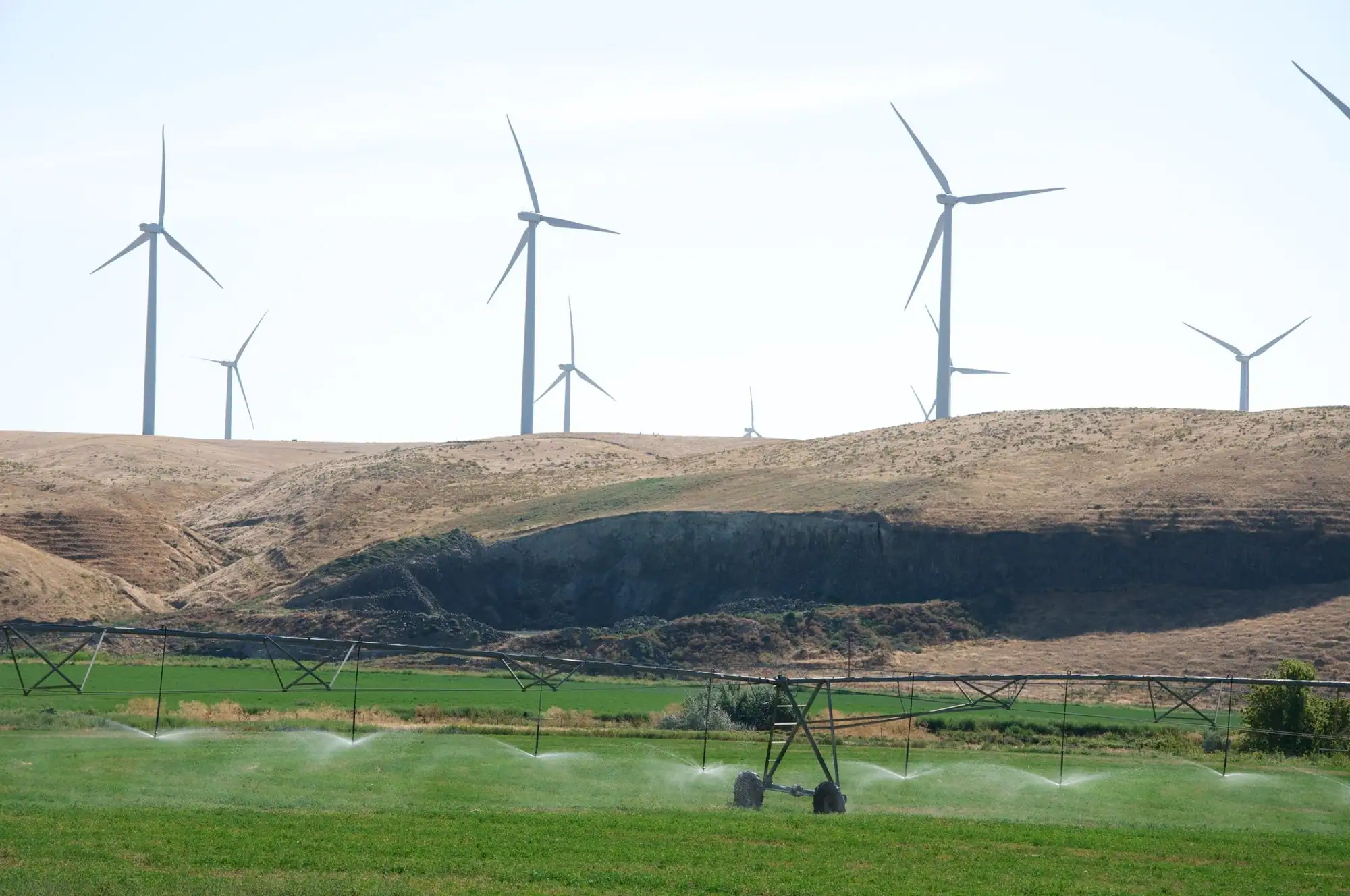
The area's soils and water made it one of the strongest vegetable-growing districts in the country. The 2024 plan notes sandy loam soils, irrigation infrastructure and climate that support potatoes, onions and carrots, along with seed crops, wheat, sweet corn, silage corn, blueberries, melons, livestock and hay. Morrow County ranked second and Umatilla County fourth among Oregon counties for agricultural production in a 2017 USDA summary cited by the plan.
That intensity has a cost below ground. A 2011 analysis by DEQ, the Oregon Department of Agriculture and Oregon State University Extension estimated the primary sources of nitrate reaching groundwater:
- about 70 percent from irrigated farmland;
- about 13 percent from large dairy and cattle operations (confined animal feeding operations);
- about 8 percent from animal pastures;
- about 5 percent from food processing facilities that reuse wastewater to irrigate fields;
- about 5 percent from residential septic systems and other sources.
The state also lists land-applied industrial wastewater permits in the area. The largest by acreage is the Port of Morrow, with about 11,718 acres, followed by Lamb Weston's Hermiston plant at about 6,018 acres and the J.R. Simplot site at about 4,415 acres, according to the 2024 plan.
What the monitoring shows
DEQ samples a network of 33 wells, 30 domestic, two irrigation and one industrial, and has tracked them for 32 years. Its January 2025 trend analysis found:
- Recently, about 40 percent of network wells exceeded 10 mg/L, compared with about 32 percent on average over the long term.
- Individual wells ranged from 0.13 to 69.7 mg/L over the period.
- High concentrations appear across the area with no simple geographic pattern, though the strongest values and trends are in the western part of the network.
- Overall trends are increasing, with more rising trends than falling ones and a slight upward trend for the network as a whole.
- Continued increases suggest nitrate is still leaching into groundwater today.
The report also says some abrupt changes in individual wells point to changes in land use, which DEQ reads as evidence that groundwater can improve when surface practices change. An earlier 2012 analysis had concluded that the original goal, declining nitrate trends by the end of 2009, was not met. Anyone quoting these findings in a paper or story should cite DEQ's report directly; our guide to researching Oregon water issues shows how to format agency reports and data.
Domestic testing adds to the picture. Reporting in March 2026 by the Oregon Capital Chronicle, published by OPB, cited OHA findings that since 2024 at least 634 domestic wells in the area contained unsafe nitrate levels, some near ten times the federal limit, with more than 420 showing elevated levels.
Who is responsible for what
Four state agencies share the work, as laid out in the 2024 plan:
- OHA runs outreach and free well testing, retesting, and water delivery or treatment for eligible households.
- DEQ writes and enforces wastewater and septic permits and tracks groundwater trends.
- The Oregon Department of Agriculture handles agricultural water quality, including complaints and manure management rules.
- The Oregon Water Resources Department oversees well construction standards and groundwater data.
A local LUBGWMA Committee, required by statute to have at least seven members representing a balance of interests, advises on local parts of the action plan. DEQ lists members from county, tribal and city governments, research institutions, irrigated agriculture, dairy and livestock, food processors, environmental groups and the public. Action plans were adopted in 1997 and 2020.
The 2024 Nitrate Reduction Plan
On September 20, 2024, the Governor's office and the four agencies published the Oregon Nitrate Reduction Plan for the LUBGWMA. It sets a goal of reducing groundwater nitrate below 7 mg/L, while protecting public health in the short term through testing and safe water. It was developed with the U.S. Environmental Protection Agency, the Confederated Tribes of the Umatilla Indian Reservation, both counties, cities and community groups. The state committed to an annual progress report.
The plan does not promise quick results. It states that cleanup will take decades, and that the most workable approach at this scale is to control sources so cleaner water gradually replaces contaminated water. Actions are grouped by timeframe: 2023 to 2027, 2027 to 2031, and 2031 onward.
Enforcement and lawsuits
Enforcement has focused heavily on land-applied wastewater. OPB has reported that DEQ issued its second-largest fine ever to the Port of Morrow in 2022 for repeated over-application of nitrogen-rich wastewater, that the port reached a $2.4 million settlement with the state the following year, and that DEQ issued a $727,000 penalty in 2024 for 800 violations and an $11,700 penalty in September 2025 for six. A DEQ spokesperson told OPB the port had violated land application limits more than 2,000 times since 2015. Port leadership has said the port accounts for roughly 3.5 percent of nitrates in the area and has committed to large treatment and storage upgrades, including new lagoons that OPB reported were due to be operating by November 1, 2025.
A federal lawsuit filed in February 2024 by Morrow County residents names the port and several farms, food processors and other companies. In March 2026, Amazon agreed to a $20.5 million settlement in that case without admitting liability, subject to court approval; the company denied contributing to the contamination. The other claims were continuing at the time of that report.
If you drink well water in the area
Test it. OHA offers free testing to residents who rely on a private well for drinking and cooking, does not ask about citizenship status, and can be reached at 541-952-9254. Oregon law also requires sellers to test domestic wells for nitrate, E. coli and arsenic during a real estate sale, though the state plan notes that requirement has no enforcement mechanism. Local well drillers, pump installers and water treatment contractors can advise on deeper wells or filtration, but the first step is a lab result.
Questions people ask
Where is the Lower Umatilla Basin Groundwater Management Area?
It covers about 550 square miles of northern Morrow and northwestern Umatilla counties, including Hermiston, Boardman, Irrigon, Stanfield and Echo, according to the 2024 state Nitrate Reduction Plan.
Is city tap water in the area affected?
DEQ says water from city or community systems is safe to drink, because public systems must test regularly and meet standards. The risk is concentrated among people who drink from private domestic wells, which are not regulated the same way.
What are the main sources of the nitrate?
A 2011 analysis by DEQ, the Oregon Department of Agriculture and OSU Extension estimated about 70 percent from irrigated farmland, 13 percent from large dairy and cattle operations, 8 percent from pastures, 5 percent from food processor wastewater applied to fields, and 5 percent from septic systems and other sources.
How do I get my well tested?
The Oregon Health Authority runs a program offering free testing, and water delivery or treatment where needed, for people in the area who drink from private wells. OHA can be reached at 541-952-9254.
Sources
- Oregon DEQ, Nitrate Contamination: Lower Umatilla Basin
- Oregon DEQ, Groundwater Management Areas
- Oregon Nitrate Reduction Plan for the LUBGWMA (Sept. 20, 2024)
- Oregon DEQ, Groundwater Nitrate Trend Analysis: LUBGWMA Well Network (Jan. 22, 2025), copy hosted by OPB
- Oregon Health Authority, LUBGWMA domestic well safety program
- OPB, Port of Morrow to spend $200 million for water quality improvements (Dec. 2022)
- OPB, Oregon increases Port of Morrow groundwater pollution fine to $2.1 million (June 17, 2022)
- OPB, Oregon DEQ again fines Port of Morrow for wastewater violations (Sept. 30, 2025)
- OPB / Oregon Capital Chronicle, Amazon to pay $20.5 million settlement (Mar. 31, 2026)