Oregon Water OnlineSalmon & riversSnowpack, climate & forecasts
Largest spring Chinook return predicted in 2010
Restored from Oregon Water Online, the 2009–2016 news blog, as captured on February 13, 2010. The text is kept as published; many items were reposts of regional news, and their source line is kept at the end. Dead links and contact details have been removed.
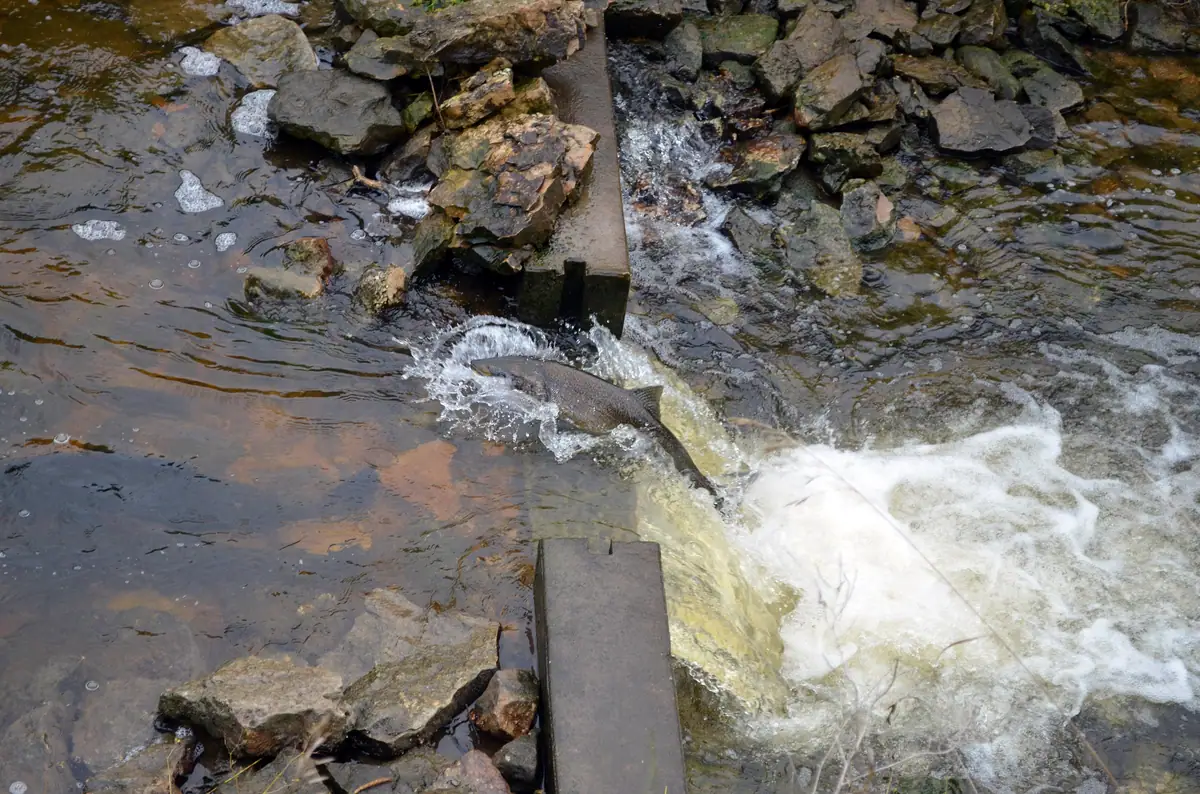
Fisheries experts this week predicted, though with a few caveats, that the new year will bring the biggest return of upriver spring chinook salmon to the Columbia River basin — 470,000 adult fish — on a record dating back to 1938.
If such a run materializes, it would break the record of 439,885 set in 2001. The forecasted run is up significantly from last year’s final run of 169,300 fish.
Forecasting the upriver spring chinook return has always been slippery slope with actual returns more often than not turning out to be well above, or well below, preseason predictions. Inexplicably, the problem has gotten worse with the four of the past six years’ preseason forecasts overestimating the adult return by an average of 45 percent.
Last year the forecast was for a return of 298,900 adult upriver spring chinook to the mouth of the Columbia River; the actual return fell short by nearly 130,000 fish.
Too rosy preseason forecasts have served to complicate management. Each of the past two years early sport and commercial fisheries were set based on the preseason forecast. But by the time managers realized the run was much smaller run than expected, the fishers had already gulped a too large of a share of their harvest allocation, which is a percentage of the upriver run.
The harvests are limited to control impacts on fish protected under the Endangered Species Act. Those stocks include the wild Snake River spring/summer chinook and the wild Upper Columbia spring chinook stocks.
The “upriver” spring chinook stocks are fish bound for hatcheries and spawning in tributaries to the Columbia and Snake above Bonneville Dam, which is located at river mile 146.
The technical committee that develops salmon and steelhead forecasts to advise Columbia River fishery managers has not yet completed 2010 forecasts for the Willamette River or other lower Columbia River basin spring chinook stocks.
Because of challenges in forecasting the spring chinook returns in recent years, members of the Technical Advisory Committee had to reconsider the analytical models they have used in past years to predict the number of returning fish.
Technical Advisory Committee members have become leery of their past dependence on the jack-4-year-old relationship in making upriver spring chinook forecasts. Jacks are 3-year-old fish (actually 2-plus years old) that mature precociously and return to freshwater after only one year in the ocean to attempt spawning.
Typically most of each year’s return is made up of 4-year-old fish that have spent two years in the ocean, so the number of jacks has long been considered a sign of the strength adult run the following year. The monster 2001 run was presaged by a 2000 jack count of 21,259 that was, to that point, the highest on a record dating back to 1960.
“Relationships between different ages of fish within a cohort have historically been fairly strong, with large jack returns resulting in large age-4 returns in the following year,” according to a Dec. 9 TAC memo describing its forecast techniques. “TAC has used these relationships to make preseason forecasts, generally by using linear regression models.”
In 2007 and 2008, the jack counts at Bonneville Dam were the third and fourth highest on record. But the adult returns the following years were modest and below expectations. “Uncertainty can be compounded when relationships between variables such as jacks to age-4s are changing, as was apparent in the 2007 and 2008,” the memo says.
A record number of spring chinook jacks, 66,630, were counted passing over Bonneville Dam in 2009. “The number of jacks that returned in 2009 was four times greater than anything we’ve seen before, which made the number a statistical anomaly,” said Stuart Ellis, current chair of TAC and a Columbia River Inter-Tribal Fish Commission fisheries biologist. “It’s something that’s never happened before.”
A variety of data is used to produce the forecasts, including harvest totals, dam counts, hatchery returns and wild return data to reconstruct the upriver spring chinook runs. TAC in-season updates its estimates, based in large part on dam counts, but can only do so after 50 percent of the run is estimated to have passed Bonneville.
“… we know the environment for young salmon appears to be changing and we need to account for that,” Ellis said.
Ellis said this year the committee considered several additional models that took into account other factors such as environmental variables — including for the first time certain “ocean indicators” charted by the NOAA Fisheries Service Northwest Fisheries Science Center.
TAC met with ocean ecologists and sought input from other scientists within and outside the TAC member agencies. Instead of a single statistical model, TAC members this year explored more than a dozen models that also considered non-linear relationships and sibling relationships. Each was then evaluated to see how it had performed in the past, i.e. how close have its forecasts been to actual returns.
The top performers, seven models in all, were then employed and they generated a range of predicted run sizes from 366,000 to 528,000 upriver adults. The committee members agreed on 470,000 as an average of the models.
The upriver forecast includes 272,000 Snake River spring/chinook, of which 73,400 are expected to be wild fish, and 57,300 Upper Columbia spring chinook (including 5,700 wild). The balance of the upriver forecast is comprised of mid-Columbia spring chinook.
“We’re comfortable with this forecast as the most reasonable assessment,” Ellis said. It’s now up to fishery managers “to make a policy level decision as to how much faith to put into it.”
“We’re still projecting a strong return for upriver spring chinook salmon next year, but we needed to temper last year’s jack return with other indicators of spring chinook abundance,” Ellis said. Even the bottom end of the forecast range would be the second highest return on record.
TAC was established under the U.S. v. Oregon litigation and includes representatives from Oregon, Idaho and Washington fish and wildlife departments, the Columbia River Inter-Tribal Fish Commission (on behalf of the Nez Perce, Umatilla, Warm Springs and the Yakama tribes) the Shoshone-Bannock Tribes, the National Marine Fisheries Service and the U.S. Fish and Wildlife Service.