Oregon Water OnlineSalmon & rivers
Clearwater Coho project nets enough adults for eggs
Restored from Oregon Water Online, the 2009–2016 news blog, as captured on February 13, 2010. The text is kept as published; many items were reposts of regional news, and their source line is kept at the end. Dead links and contact details have been removed.
Nez Perce Tribe officials on Thursday for the first time in the 15-year history of the Clearwater Coho Restoration Project delivered fertilized coho salmon eggs from Idaho back to a western Oregon hatchery that has enabled the coho program to take wing.
The delivery included approximately 600,000 bright orange “eyed” coho salmon eggs collected from fish returning to the Clearwater River basin and spawned at Dworshak National Fish Hatchery in west-central Idaho.
The Eagle Creek National Fish Hatchery in Estacada, Ore., will incubate the eggs and rear the resulting juvenile coho until March 2011. The juvenile coho will then be transported back to the Clearwater where they will be acclimated and outplanted into basin streams.
Space limitations in the Clearwater basin at Dworshak National Fish Hatchery and Kooskia National Fish Hatchery limit the tribe’s ability to rear the eggs to produce juveniles for release. The Eagle Creek hatchery is located approximately 40 miles southeast of Portland.
The delivery of these eggs represents the first time that enough adult coho returned to the Clearwater basin in Idaho to provide a full supply of eggs for the limited production in Idaho and the space at Eagle Creek. It is a big step toward establishing a localized Clearwater River coho salmon broodstock via supplementation.
The Eagle Creek hatchery has served as the backbone to the Nez Perce Tribe’s coho project for the past 10 years, acting as the major producer for juvenile coho for outplanting in the Clearwater basin. Until now Eagle Creek used eggs from coho that got their start in the lower Columbia. The Nez Perce project got its start in 1994.
“The arrival of these eggs begins the transition to upriver brood sources for the second phase of the Clearwater coho reintroduction master plan — an important landmark in re-establishing a self-sustaining coho population in the Clearwater River,” said Larry Telles, hatchery manager for the U.S. Fish and Wildlife Service’s Eagle Creek NFH.
“Once re-established, these fish will act as a critical piece of the ecological puzzle in the restoration of other salmon and steelhead populations of that system.”
“It’s taken 15 years for these coho to come full circle,” said Mike Bisbee, coho project leader for the Nez Perce Tribe. “The demonstrated success of these salmon over the past few years speaks volumes about their instinct to survive and their determination to come home. Coho are extremely forgiving and runs can rebuild quickly. We’re helping them do that.”
The Nez Perce Tribe’s CCRP, funded by the Pacific Coast Salmon Recovery Fund through NOAA Fisheries, is successfully rebuilding naturally spawning coho runs to the Clearwater River and its tributaries. Coho produced by the Nez Perce Tribes’ CCRP contribute to Columbia Basin and coastal ocean fisheries.
Coho salmon were extirpated in the Clearwater River following the installation of the Lewiston Dam, which had fish ladders that proved to be inadequate for passing salmon upriver, in 1927.
A restoration attempt was made by the Idaho Department of Fish and Game from 1962 to 1968 in the South Fork of the Clearwater River. But the effort largely failed due to ice formation, de-watering, flooding and siltation and other factors so the program was discontinued, according to a NPT summary of the Clearwater coho program history.
Coho salmon were officially declared extirpated from the Clearwater River in 1986. With the dam long-since removed (in 1973), the tribe was eager to give coho reintroduction a try. The CCRP began as a result of a U.S. V. Oregon agreement between tribes, Idaho, Oregon and Washington, and federal agencies. In the agreement, surplus coho eggs from lower Columbia River hatcheries were to be used to reintroduce the species in the Clearwater subbasin.
The overall goal of the CCRP is to restore coho to the Clearwater River subbasin at levels of abundance and productivity to support sustainable runs and annual harvest. The Nez Perce Tribe plan envisions developing an annual escapement of 14,000 coho salmon to the subbasin. That number would support broodstock needs, natural production and harvest for both tribal and non-tribal members.
The run bottomed out from 1984 through 1996 when only two coho were counted crossing the lower Snake River’s Lower Granite Dam on their way to the Clearwater. The first results from the NPT program were witnessed in 1997 when 93 adult coho were counted at the dam.
The returns have since been on an upward trend, with some peaks (3,904 fish counted in 2004) and valleys. The count was 4,770 in 2008 and this year boosted the record count to 4,910.
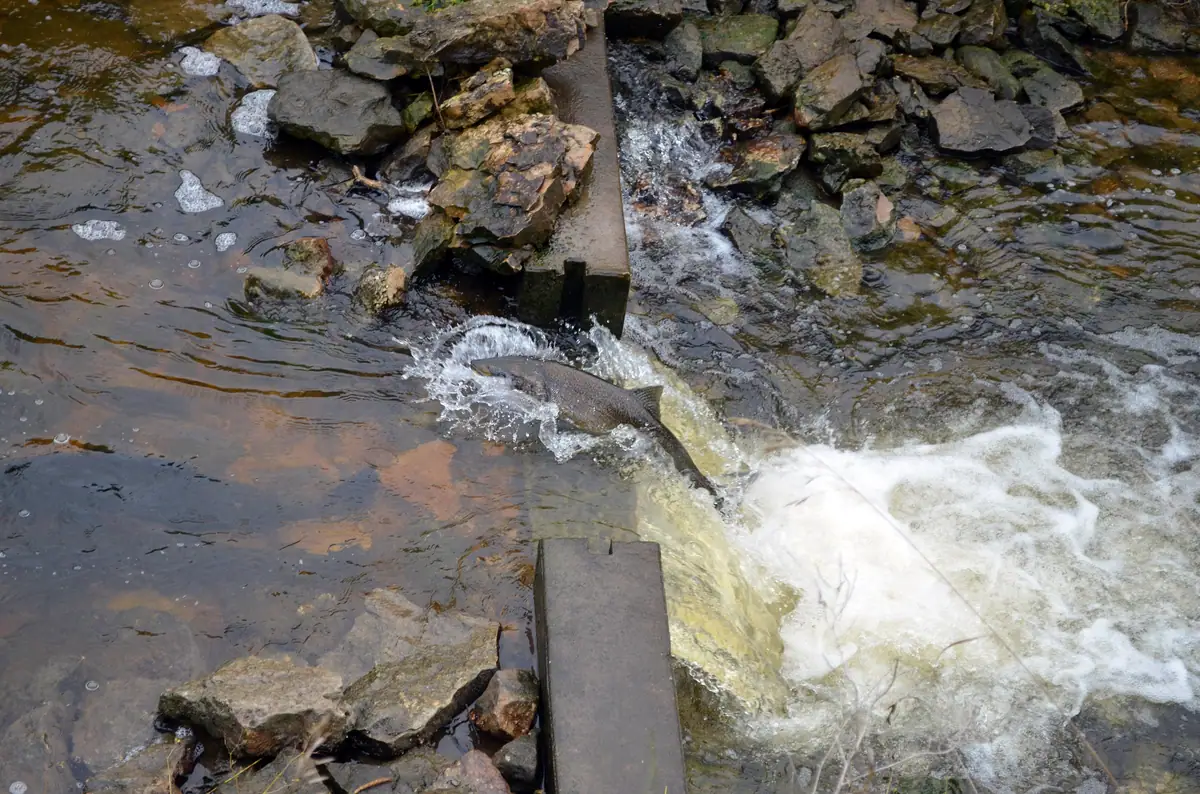
In the fall of 2009, returning adult coho were trapped at weirs at Dworshak NFH on the North Fork of the Clearwater and Kooskia NHF, on Clear Creek, for spawning at the Kooskia facility. The juvenile fish produced are reared for a year and a half, mostly at Eagle Creek.
This year, 550,000 coho smolts were imported from Eagle Creek NFH, and directly released into Lapwai (275,000) and Clear (275,000) creeks. Another 30,000 coho fry are reared by the Potlatch Corporation and directly released into Orofino Creek in May of each year.
There is some natural spawning of returned adults in the lowest reaches of the North Fork and Clear Creek and up and down Lapwai Creek, according to Bisbee.
Additionally, some adult returns that are surplus to hatchery needs are outplanted in Lolo Creek in hopes that they will spawn naturally. Lolo is a tributary that feeds into the Clearwater about halfway between Dworshak and Kooskia hatcheries.
Another 280,000 coho juveniles are incubated, hatched, and reared at Dworshak and Kooskia hatcheries.