Written in 2026 for this archive, not by the Oregon Water Coalition. It explains background that the restored pages take for granted; check current rules with the agencies named in the sources before acting on anything here.
For people in Hermiston, Boardman and the Tri-Cities, the federal dams on the Columbia and Snake are not abstractions. They are the pool behind McNary that feeds Umatilla Basin pumps, the barge route that carries regional wheat, and part of the power supply. They are also central to a decades-long dispute over salmon and steelhead that keeps returning to federal court. This guide lays out the main facts on each side, drawing mainly on Congressional Research Service reports, federal agency records and the Northwest Power and Conservation Council.
The system in brief
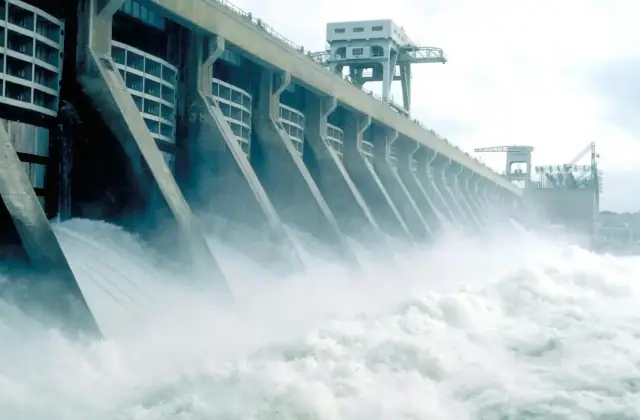
Bonneville Dam, finished in 1938, was the first dam in what became the Federal Columbia River Power System. CRS counts 31 federal hydropower dams in the basin, operated by the Army Corps of Engineers or the Bureau of Reclamation, with power marketed by the Bonneville Power Administration. Fourteen of the main-stem facilities are treated together as the "Columbia River System," and four of those are on the lower Snake River.
Those four, built by the Corps with navigation locks, turned the lower Snake into a chain of reservoirs and allowed barges to reach Lewiston, Idaho, starting in 1975.
| Dam | Began operating | Nameplate capacity (CRS) |
|---|---|---|
| Ice Harbor | 1962 | 603 MW |
| Lower Monumental | 1969 | 810 MW |
| Little Goose | 1970 | 810 MW |
| Lower Granite | 1975 | 810 MW |
The Snake once ranked among the most productive salmon rivers in the basin. Its tributaries, particularly the Salmon River, still hold large blocks of undammed habitat upstream of the four dams. Snake River sockeye make one of the longest salmon migrations anywhere, about 900 miles from the Pacific to Redfish Lake in Idaho, the only remaining population.
What is listed, and since when
CRS lists four Snake River salmon and steelhead groups under the Endangered Species Act:
- Snake River sockeye salmon, endangered, listed 1991;
- Snake River spring/summer Chinook, threatened, 1992;
- Snake River fall Chinook, threatened, 1992;
- Snake River steelhead, threatened, 1997.
Across the whole Columbia Basin, CRS counts 13 listed salmon and steelhead population segments, each threatened or endangered. Coho once used the Snake but were considered extirpated there before the 1950s.
Fish passage at the dams
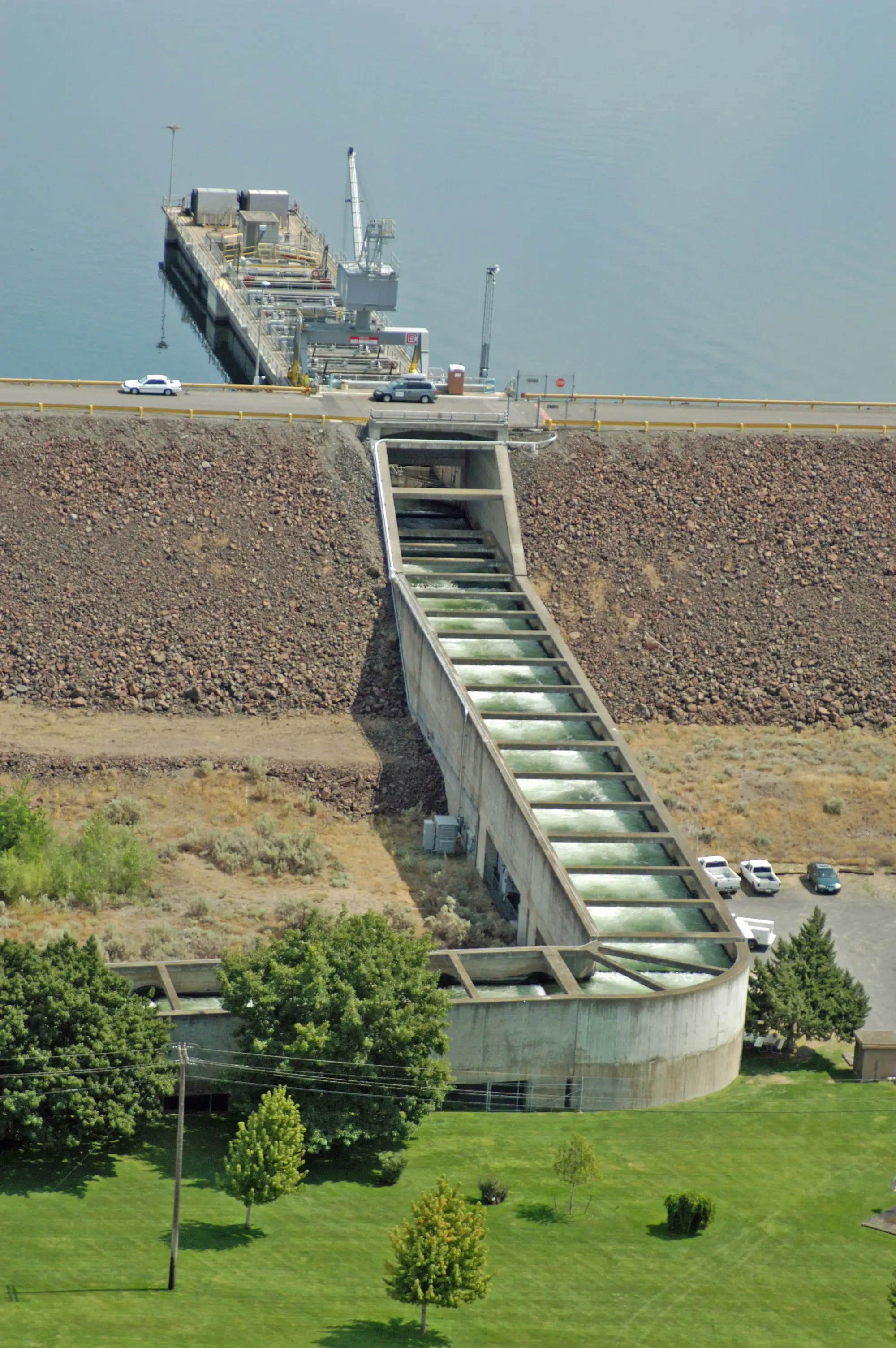
The dams were built with fish ladders for returning adults, and the Corps has modified them over time. For juveniles heading downstream, CRS describes a set of tools: surface passage structures such as spillway weirs, bypass systems, turbine designs that reduce the number of fish drawn into turbines, and spill, meaning water deliberately passed over spillways instead of through turbines to improve juvenile survival.
Spill is where fish and power collide most directly. Water sent over the spillway generates no electricity, so every spill decision has a cost on the power side. That tradeoff is behind most of the operational fights described below.
Hatcheries and the fish and wildlife program
Hatcheries have been part of the response for decades. Wikipedia's Snake River article summarizes the record: since the 1950s, agencies, tribes and utilities have invested heavily in restoration and hatchery programs, with limited success.
Under the Northwest Power Act of 1980, BPA funds a fish and wildlife program guided by the Northwest Power and Conservation Council. CRS lists three main types of BPA-funded projects: fish passage structures, hatchery construction and maintenance, and habitat work including land acquisition. In 2008 BPA signed the Columbia Basin Fish Accords with seven tribes, two federal agencies and three states, committing funding for operations, habitat and hatcheries; extended several times, the accords expired on September 30, 2025.
The Umatilla River offers a local example. The Confederated Tribes of the Umatilla Indian Reservation worked with state, federal and irrigation partners on a hatchery and reintroduction program; fall Chinook were reintroduced in 1982 and 1983 and spring Chinook in 1986, after the species had been gone from the basin since the 1920s, according to the Oregon Encyclopedia.
Predation: birds and sea lions
Dams are not the only pressure. CRS lists climate change, drought, development, pollution and predation, including by pinnipeds, native and non-native fish, and colony-nesting waterbirds.
Caspian terns
In the late 1990s the Caspian tern colony on Rice Island, a dredge-spoil island in the Columbia River estuary, was considered the largest in the world. A Corps biologist told the Northwest Power and Conservation Council in 2018 that ESA-listed salmonids made up 83 percent of the terns' diet there. The Corps used fencing and hazing to move the birds about 10 miles downstream to East Sand Island, where marine fish are more available; the listed-salmon share of the diet dropped to about 30 percent. A federal management plan set a target of 3,125 breeding pairs, and the Corps built alternative tern islands in south-central Oregon and near San Francisco Bay.
Sea lions
California sea lions began showing up in numbers in the lower Columbia in the 1990s and reached Bonneville Dam by 2000; Steller sea lions followed from the early 2000s. NOAA reports that Steller sea lions were first documented at Bonneville in 2003, three animals, and that at least 66 were seen there on a single day in 2018.
CRS compiles Corps estimates of salmonids eaten below Bonneville. The highest count in the recent series was in 2015, about 10,859 fish consumed, 4.5 percent of the run; by share of the run, 2016 was higher at 6.2 percent. In 2024 the estimate was 2,253 fish, about 2.8 percent. Sampling since 2020 covers shorter periods, so recent numbers are not strictly comparable with earlier ones.
Congress allowed lethal removal under Section 120 of the Marine Mammal Protection Act in 1994 and broadened it with the Endangered Salmon Predation Prevention Act of 2018. NOAA issued a five-year permit in 2020 to Idaho, Oregon, Washington and tribal parties; renewed in 2025, it authorizes removal of up to 424 California and 62 Steller sea lions through August 2030. Supporters, including state fish agencies, call removals necessary. Other stakeholders object and point to climate, hydropower and food-web factors as larger drivers, CRS notes.
Biological opinions and the courts
Federal dam operators have consulted with NOAA Fisheries under the ESA since the mid-1990s, and stakeholders have repeatedly sued over the resulting biological opinions. The litigation that has shaped the past two decades began with a challenge to a 2000 biological opinion, filed by the National Wildlife Federation and others.
A 2016 federal court decision required the agencies to consider dam removal in their next environmental review. They did, in a 2020 environmental impact statement, but did not choose it. The September 28, 2020, record of decision kept the four dams and increased flows through several dams at certain times for migrating fish. Plaintiffs then challenged the 2020 biological opinion, EIS and record of decision.
The 2023 agreement and its reversal
In December 2023 the parties asked the court to pause the case, and it granted a stay running through 2028 so the federal government could carry out a memorandum of understanding supporting the Columbia Basin Restoration Initiative, a plan developed by four tribes and the states of Oregon and Washington. It included ten years of interim dam operations and studies of how to replace the services the lower Snake dams provide. It did not itself authorize removal, which would take an act of Congress.
On June 12, 2025, President Trump revoked the underlying 2023 presidential memorandum and directed agencies to withdraw from the agreement, citing the more than 3,000 megawatts of generating capacity at the four dams along with shipping, irrigation and recreation. Plaintiffs moved to lift the stay, and the court granted it on September 11, 2025. On March 2, 2026, the court issued a preliminary injunction that generally keeps spill and reservoir levels from the 2025 fish operations plan. The government appealed to the Ninth Circuit.
The arguments, side by side
Supporters of keeping the dams point to:
- Power. CRS cites more than 3,000 MW of nameplate capacity and, from the 2020 EIS, more than 2,000 MW of sustained winter peaking capability and a quarter of BPA's reserve-holding capability.
- Navigation. Snake River barges carry about 2.5 to 3 million tons of wheat a year, a little over 20 percent of the wheat loaded at deep-draft terminals between Portland and Longview, by CRS's figures.
- Irrigation and local economies along the reservoirs.
Supporters of breaching point to:
- Fish recovery. Despite decades of passage improvements and hatchery spending, listed Snake River populations remain low, and some scientists identify the four dams as a primary limiting factor, as CRS notes.
- Tribal treaty rights to fish, which federal courts have recognized.
- Cost comparisons. Estimates of the cost to replace the dams' benefits have ranged from $10 billion to $31 billion, mostly for power and grid services. CRS stresses that significant uncertainty remains about the effects and costs of most options, which the width of that range reflects.
What is not in dispute: the fish are still listed, the dams are still operating, and the next decision point is as likely to come from a courtroom or from Congress as from the agencies that run the river.
Questions people ask
What are the four lower Snake River dams?
Ice Harbor (began operating in 1962), Lower Monumental (1969), Little Goose (1970) and Lower Granite (1975). The U.S. Army Corps of Engineers owns and operates all four, and each has navigation locks and fish passage facilities.
Which Snake River salmon and steelhead are listed under the Endangered Species Act?
Snake River sockeye salmon (endangered, 1991), spring/summer Chinook (threatened, 1992), fall Chinook (threatened, 1992) and steelhead (threatened, 1997), according to the Congressional Research Service.
How much power do the lower Snake dams produce?
CRS reports a combined nameplate capacity of more than 3,000 megawatts, about 17 percent of Federal Columbia River Power System capacity, with annual output around one-tenth of BPA's system-wide generation. The 2020 EIS credited them with more than 2,000 MW of sustained winter peaking capability.
What is the current legal status of the dam operations dispute?
Litigation over the 2020 biological opinion, EIS and record of decision resumed in September 2025 after the federal government withdrew from a 2023 agreement. In March 2026 a federal court issued a preliminary injunction that generally keeps spill and reservoir levels from the 2025 fish operations plan; the government appealed.
Sources
- Congressional Research Service, Columbia River System Operations and the Future of the Lower Snake River Dams (R49059)
- Congressional Research Service, Sea Lion Predation on Columbia River Salmon and Steelhead (IF11045, June 2026)
- Presidential Memorandum, Stopping Radical Environmentalism To Generate Power for the Columbia River Basin (June 12, 2025)
- NOAA Fisheries, MMPA Section 120 Pinniped Removal Program
- Northwest Power and Conservation Council, With nesting area relocated, Caspian terns feast on fewer fish (2018)
- Wikipedia, Snake River
- Oregon Encyclopedia, Umatilla River